44th Huggins Science Seminar
, - (1 Hour 30 Minutes)
Lecture / Seminar Accessible Parking Accessible Washrooms Wheelchair Accessible All Ages
[email protected]
9025851472
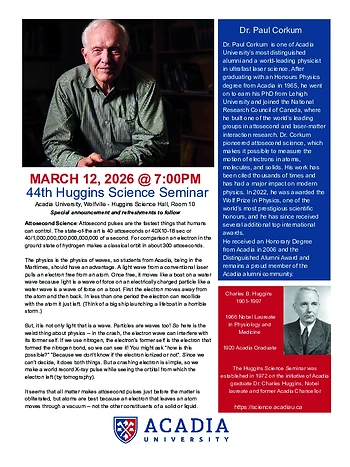
Dr. Paul Corkum is one of Acadia University’s most distinguished alumni and a world-leading physicist in ultrafast laser science. After graduating with an Honours physics degree from Acadia in 1965, he went on to earn his PhD from Lehigh University and joined the National Research Council of Canada, where he built one of the world’s leading groups in attosecond and laser-matter interaction research. Dr. Corkum pioneered attosecond science, which makes it possible to measure the motion of electrons in atoms, molecules, and solids. His work has been cited thousands of times and has had a major impact on modern physics. In 2022, he was awarded the Wolf Prize in Physics, one of the world’s most prestigious scientific honours, and he has since received several additional top international awards. He received an Honorary Degree from Acadia in 2006 and the Distinguished Alumni Award and remains a proud member of the Acadia alumni community.
The Huggins Science Seminar was established in 1972 on the initiative of Acadia graduate Dr. Charles Huggins, Nobel laureate and former Acadia Chancellor.
The Nobel Prize will be on display at the seminar. Special announcement and refreshments will follow the seminar.
Attosecond Science: Attosecond pulses are the fastest things that humans can control. The state-of-the art is 40 attoseconds or 40X10-18 sec or 40/1,000,000,000,000,000,000 of a second. For comparison an electron in the ground state of hydrogen makes a classical orbit in about 300 attoseconds. The physics is the physics of waves, so students from Acadia, being in the Maritimes, should have an advantage. A light wave from a conventional laser pulls an electron free from an atom. Once free, it moves like a boat on a water wave because light is a wave of force on an electrically charged particle like a water wave is a wave of force on a boat. First the electron moves away from the atom and then back. In less than one period the electron can recollide with the atom it just left. (Think of a big ship launching a lifeboat in a horrible storm.) But, it is not only light that is a wave. Particles are waves too! So here is the weird thing about physics -- in the crash, the electron wave can interfere with its former self. If we use nitrogen, the electron’s former self is the electron that formed the nitrogen bond, so we can see it! You might ask “how is this possible?” “Because we don’t know if the electron ionized or not”. Since we can’t decide, it does both things. But a crashing electron is simple, so we make a world record X-ray pulse while seeing the orbital from which the electron left (by tomography). It seems that all matter makes attosecond pulses just before the matter is obliterated, but atoms are best because an electron that leaves an atom moves through a vacuum -- not the other constituents of a solid or liquid.
[email protected]
9025851472
Dr. Paul Corkum is one of Acadia University’s most distinguished alumni and a world-leading physicist in ultrafast laser science. After graduating with an Honours physics degree from Acadia in 1965, he went on to earn his PhD from Lehigh University and joined the National Research Council of Canada, where he built one of the world’s leading groups in attosecond and laser-matter interaction research. Dr. Corkum pioneered attosecond science, which makes it possible to measure the motion of electrons in atoms, molecules, and solids. His work has been cited thousands of times and has had a major impact on modern physics. In 2022, he was awarded the Wolf Prize in Physics, one of the world’s most prestigious scientific honours, and he has since received several additional top international awards. He received an Honorary Degree from Acadia in 2006 and the Distinguished Alumni Award and remains a proud member of the Acadia alumni community.
The Huggins Science Seminar was established in 1972 on the initiative of Acadia graduate Dr. Charles Huggins, Nobel laureate and former Acadia Chancellor.
The Nobel Prize will be on display at the seminar. Special announcement and refreshments will follow the seminar.
Attosecond Science: Attosecond pulses are the fastest things that humans can control. The state-of-the art is 40 attoseconds or 40X10-18 sec or 40/1,000,000,000,000,000,000 of a second. For comparison an electron in the ground state of hydrogen makes a classical orbit in about 300 attoseconds. The physics is the physics of waves, so students from Acadia, being in the Maritimes, should have an advantage. A light wave from a conventional laser pulls an electron free from an atom. Once free, it moves like a boat on a water wave because light is a wave of force on an electrically charged particle like a water wave is a wave of force on a boat. First the electron moves away from the atom and then back. In less than one period the electron can recollide with the atom it just left. (Think of a big ship launching a lifeboat in a horrible storm.) But, it is not only light that is a wave. Particles are waves too! So here is the weird thing about physics -- in the crash, the electron wave can interfere with its former self. If we use nitrogen, the electron’s former self is the electron that formed the nitrogen bond, so we can see it! You might ask “how is this possible?” “Because we don’t know if the electron ionized or not”. Since we can’t decide, it does both things. But a crashing electron is simple, so we make a world record X-ray pulse while seeing the orbital from which the electron left (by tomography). It seems that all matter makes attosecond pulses just before the matter is obliterated, but atoms are best because an electron that leaves an atom moves through a vacuum -- not the other constituents of a solid or liquid.
Admission
Pricing: Free
Huggins Science Hall
 |